 |
Applications
Development Trends |
 |
| Management Spotlight: Cannondale Corp.
High-end bicycle manufacturer keeps track of the cycles September 1998/By Jason J. Meserve |
|
|
There have been a few themes running through the computer industry in the last year: network computing, reuse and, of course, the Internet. Bedford, Pa.-based Cannondale Corp., a maker of high-end bicycles, is bringing all three of these themes together in an effort to make its software and manufacturing systems more flexible.
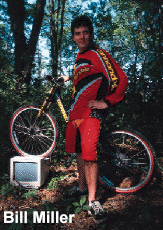
Prior to electronically publishing its manufacturing how-to information, the company relied on paper-based instructions that followed each order around the shop floor, said Bill Miller, an application engineer at Cannondale. "We have ways to set up everything based on a number of parameters," he explained. "[For example,] we have one fixture that can weld all the frames that use different measures to set up a fixture." However, the paper-based system caused inventory levels to fluctuate as it was difficult to track materials. It was also difficult to track bottlenecks in the manufacturing process. "When I came on the scene two years ago, we started looking at different ways to get the manufacturing instructions out to the floor more efficiently," Miller said. "We looked at the Web and figured the applications on the shop floor were well suited toward it." Working alone, Miller built a system that serves, for the most part, HTML pages containing manufacturing instructions out to computers on the shop floor. A few of the more complicated systems, such as bar code scanning, were built using a fourth-generation (4GL) tool. In turn, each order is tracked by a database as it proceeds through the manufacturing process. Miller used WebSpeed and Progress from Progress Software Corp., Bedford, Mass., for the majority of the programming. Cannondale already had a Progress database system in-house, which made WebSpeed a logical choice. "For a Progress shop, the learning curve is real easy," Miller said. "I looked into Perl and scripts, but already knowing Progress made development quick." The first application Miller built took two to three weeks, with some delay attributed to the fact that he had never done HTML coding before. Miller hand codes most of the HTML since he is not impressed with any of the WYSIWYG HTML editors currently available. Since building his first scheduling application a year-and-a-half ago, Miller has become more proficient with Progress and WebSpeed, banging out prototype applications in "two or three hours," he said. "We have this very dynamic, flexible manufacturing system out on the floor, so our software systems have to work the same way," Miller said. "We have to be able to change software quickly so we can communicate new models to the floor. That's where we like the Web-based system." Today, there are a number of Progress- and WebSpeed-based systems running on the floor. One that Miller is most proud of tracks how long (in minutes) it takes to weld each bicycle frame. As each frame is completed, the welder uses a bar code scanner to input each frame's serial number into the system. "This helps people work at a steadier speed and gives them a landmark to shoot for," Miller said. Another benefit of the tracking system is that it gives workers more time to inspect their work. "We want each employee to act as an inspector," he said. "This helps keep our manufacturing process as small as possible." Miller recently installed a 29-inch television above the floor to act as a scoreboard. This allows each row of the shop floor to see how it is doing in relation to its neighbors. After all, a little friendly competition never hurt. Another advantage to using a Web-based system is that it allows Cannondale to reuse a number of old 486 computers. Because the shop floor is not well suited to a computing environment, with machine noise and aluminum dust just two of the potential hazards, the simpler the hardware configuration the better. Most of the systems do not have keyboards or mice, and are considered "throw-away systems. "We looked at the whole NetPC thing, but that was immature a year ago and expensive compared to what you can do with a regular computer," said Miller. "We've got it down to a CPU, bar code scanner and monitor on some machines." In addition to completing system rollout throughout the company, Miller is building a complex tracking system that will allow Cannondale to not only track orders as they move through the shop, but individual frames as well. This will enable the company to keep inventory levels as low as possible. And while Cannondale only makes special prototype bikes for its racing team, Miller hopes the new, flexible software infrastructure will allow the company to make customized bikes on a regular basis. Who knows, maybe the firm will even build a bike with built-in Web browsing for those really long rides. photo by c.e.mitchell / blackstar
|
 Cannondale manufactures
approximately 250,000 mountain, road, hybrid, touring and tandem
bikes annually. The company also launches six new product lines
every year, three in the United States and three in Europe. All
of this adds up to around 150 different bicycle frame types that
the firm must build each year.
Cannondale manufactures
approximately 250,000 mountain, road, hybrid, touring and tandem
bikes annually. The company also launches six new product lines
every year, three in the United States and three in Europe. All
of this adds up to around 150 different bicycle frame types that
the firm must build each year. 1998 Software Productivity Group/A Ullo International Inc.
Company One Apple Hill, Suite 301, Natick, MA 01760
(508) 652-1100 FAX (508) 652-1210
e-mail:general@spgnet.com http://www.adtmag.com
|
Applications
Development Trends |
|