
|
|
|
|
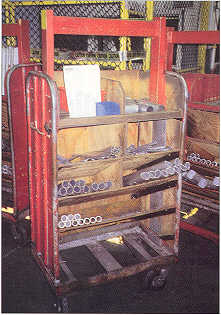
The process is so fast and quiet that it's easy to forget what a miracle it is that a beam of light is doing the cutting. The workman hasn't moved a muscle, except to move the finished seatstay bridges to the appropriate bin on the cart. When he's finished cutting tubes for that work order, he swipes the bar code on the cart, and instantly computers throughout Cannondale's intranet know that part of the job has been completed. Some of the more difficult tubing cuts are made on the plasma cutter. This tool is programmed to leave behind |
small tabs on the mitered ends.
The tabs fit into slots cut into the tubes. The patented tab-and-slot construction,
which is buried underneath a massive weld bead later that day, is key to
Cannondale's manufacturing flexibility. It allows the next step - tack welding
- to be vastly simpler and more versatile than in other factories.
In most factories, the mitered tubes are mounted in a massive jig that holds them in exactly the right place. A workman zaps each joint with a tack weld. Then the frame is removed from the jig and the finish welds, which go around the full circumference of each joint, are performed. But at Cannondale, the massive jig isn't part of the picture. The tab-and-slot construction allows them to use much simpler tooling, which can be changed almost instantly, for the tack welding process. (Exactly what jigging is used at this stage is another of the company's secrets, and my camera and I weren't offered a show.) After tack welding, an army of finish welders stand ready to perform the finish welds. These welders are an impressive bunch. the raw welds took quite good when the frames leave their work stations. As each frame is welded, a quick zap of the bar code records the progress, and the computer knows how many of the 10 frames have been welded. The next step is finish work. In the one part of the factory that's downright noisy, guys in moon suits with rotary files smooth out the welds. After that comes the first stage of heat treatment, final alignment. and then the second stage of heat treatment. Again, the bar code is zapped at a nearby computer (an old, nearly worthless 486 machine running Netscape), and the intranet's database is updated. So why not use a clipboard, pencil and checklist instead? "This way. our main computer knows where the order is inside the factory," Miller said. "We can communicate everything we need to know about the bicycle, and how to make it, to the factory floor. We're able to be very responsive to the consumer and the dealer this way. Some of these frames @,o overseas for final sale and assembly. With this system, our people there can access this information as easily as we can." So can the people who order tube stock and other raw materials. So can sales, accounting and marketing executives at the corporate headquarters in Bethel, Connecticut. All this accounting and sales information is important, because the next step the frames take is to a warehouse area called "unfinished goods," where row upon row of unpainted frames await painting and final assembly. |
|
|
Page 2
|
|