By Blaise Zerega
 The
modern bicycle is a study in contrasts: It is the melding of mechanical
simplicity and high-tech components to create a top-performing
machine. Likewise, by combining manufacturing floor machinery
with Web-based, thin-client technologies, Cannondale has been
able to create processes and a top-performing production line
for producing its sophisticated bicycles.
The
modern bicycle is a study in contrasts: It is the melding of mechanical
simplicity and high-tech components to create a top-performing
machine. Likewise, by combining manufacturing floor machinery
with Web-based, thin-client technologies, Cannondale has been
able to create processes and a top-performing production line
for producing its sophisticated bicycles.
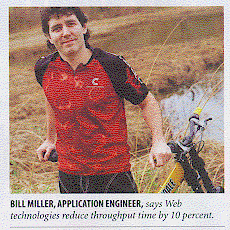
According to Bill Miller, application engineer at Cannondale,
browser technology and automated product tracking and inventory
systems have enabled Cannondale's assembly plant to expand from
manufacturing one product line of about 50 bike models three years
ago to six lines with roughly 120 models for introduction in 1999.
What's more, the new bicycles will be produced 10 percent faster
than before.
Based in Bethel, Conn., Cannondale has one manufacturing plant
in Bedford, Penn., where all of its bicycles are produced. Its
annual revenues total about $170 million.
Creative uses of HTML play a large part in Cannondale's revamped
manufacturing processes. The company has 15 Web-enabled computer
workstations deployed at critical data-collection points along
the manufacturing and assembly line, such as frame stamping and
laser cutting of bicycle tubes.
Using a WebSpeed database and development tools from Progress
Software, Miller created a system that links custom-designed Web
pages on the factory floor with an AS/400-powered materials requirement
planning application.
Workers on the factory floor use a bar-code scanner to navigate
Web pages containing data fields that track a product's status
through manufacturing. The application also helps to measure material
inventory levels. Miller explains that creating this application
was a straightforward process.
"Using JavaScript, I was able to get full control of the cursor
and link bar-code scanners to data input," Miller says.
Miller saved money by building the system with recycled 486 PCs
from other parts of the company. He re-used only their monitors,
hard drives, and network cards. Instead of keyboards, he equipped
the PCs with bar-code scanners -- their only data-input device.
These devices are inexpensive and easy to maintain, and easy to
replace if necessary.
"We got three stripped-down workstations for what it would have
cost to buy one `industrial-grade' workstation," Miller says.
Cannondale bicycles feature complex paint jobs using colors such
as "Afterburner Orange," for a dramatic result. Previously, painters
relied on thick binders containing color illustrations and detailed
instructions on paper. Updating the binders at the Pennsylvania
factory with new drawings from designers at the Connecticut headquarters
could take as long as two weeks.
Now, product designers create their illustrations with Adobe
Illustrator and convert them to the JPEG format for uploading
into the WebSpeed database. The illustrations are HTML-tagged
by model number and name, for instance. Once prepared, the illustrations
are dynamically rendered as their own Web pages, easily accessible
from PCs by painters at the factory.
Aside from eliminating the cumbersome binder system, the system
also provides the Cannondale Web site (www.cannondale.com)
with illustrations, ensuring customers will receive exactly what
they see online.
"This is all about network computing. We can send updates immediately
across the organization," Miller says. "It's about efficiency."
And efficiency, as any cyclist knows, is the name of game.





