|
| |
| Cyberspace
goes blue-collar |
| |
| The
Web is moving onto the factory floor, offering an inexpensive means
to link workers, machines, information |
|
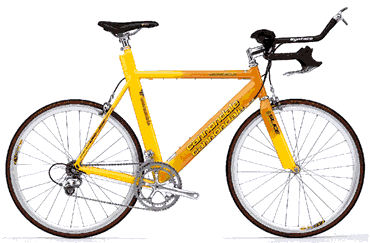 |
| Cannondale
uses the Web to, among other things, get the color right on new
models |
|
|
By
James E. Gaskin, Inter@ctive Week Online
ZDNN |
|
| Aug.
17 — Cannondale
Inc. is the world’s leading manufacturer of aluminum bicycles, producing
more than 60 models for the U.S. market alone. New designs are developed
in Connecticut six times per year, then assembled in Pennsylvania
and hand-painted for quality. But getting the color right when a
new model comes out has been something of a guessing game. So what’s
a painter to do? |
| |
|
|
|
|
|
“Two
years ago, we only had text descriptions for the painters. Last
year, we had a booklet with pictures, [which was] almost immediately
out of date. Now, we have the same electronic image for each bicycle
model everywhere.”
—
BILL MILLER
Cannondale
engineer |
|
NOW, THE ANSWER IS simple, even for a $164 million manufacturer
such as Cannondale. The painter just checks the instructions and
color picture on the company’s Web server.
Cannondale is just one company that has added Web technology to
its manufacturing process over the past two years. Suddenly, the
World Wide Web is moving onto the factory floor, providing companies
with an inexpensive means to link workers and the machines they
operate to remote repositories of information. Distant managers
now watch what’s going on, literally, from wherever they are.
With tiny Web cameras and Web displays being built directly into
equipment deployed on assembly lines, using Internet technologies
to speed products to market is not just the province of software
companies and other purveyors of digital goods. Smokestack industries
are revving up the speed and quality of delivering to market everything
from tool machines to wood panels.
“Using browser technology as the standard interface has training
advantages and saves software development time and trouble,” said
Dennis Byron, an analyst at International Data Corp. Software that
integrates Internet technologies into factory operations is a small
but growing portion of a $4.8 billion market for prepackaged manufacturing
software, which itself is growing 14.2 percent a year, according
to IDC.
In the Cannondale case, designs produced at the company’s Bethel,
Conn., headquarters, go into a Progress Software Corp. WebSpeed
database as drawings.
Supervisors on the production floor take the designs and add a bill
of material, listing all of the parts needed to make the new model.
Prototypes are built based on the drawing; then they are photographed.
The photographs replace the design drawing in the WebSpeed database,
providing designers, production workers, painters and customers
the same picture through the Web site.
When the bicycle is in production in Bedford, Pa., assembly instructions
and painting examples are listed on Web client stations for all
employees to see. The paint job a customer sees on the Web site
is the exact same hand-applied paint job the bicycle will receive.
“Two years ago, we only had text descriptions for the painters,”
engineer Bill Miller said. “Last year, we had a booklet with pictures,
[which was] almost immediately out of date. Now, we have the same
electronic image for each bicycle model everywhere.”
USING THE WEB
AS A WINDOW
The Web
has just begun to make its first tentative steps onto the factory
floor at Northern Telecom Ltd., but it will enter almost every aspect
of the telecommunications giant’s manufacturing operations in the
years ahead.
At Nortel’s Westwinds wireless plant in Calgary, Alberta, which
manufactures base stations for cellular phone networks, factory
workers tap into the company’s intranet to retrieve a wide range
of documents related to health, quality control and safety, as well
as general operating procedures.
Those documents have been replaced by COSMOS — COmmon Sense Management
Operating System — which essentially is an online repository on
Nortel’s intranet for all of the documents related to the manufacturing
process.
Vince Guthro, COSMOS project manager, said that when workers had
questions related to manufacturing procedures, they traditionally
would thumb through stacks of binders filled with diagrams, manuals
and policy guidelines to find the answers.
“It’s saved a couple of forests, and we don’t have people running
around constantly updating binders,” Guthro said. “More importantly,
COSMOS allows our employees to get to the information they need
faster.”
Nortel conducted an experiment to test the benefits of the system
by asking an employee to find documentation relating to the effect
of static electricity on the wireless base stations they produce.
Guthro said it took 45 minutes for the worker to find the correct
documents by thumbing through the binder library — and only five
minutes to find the same documents on COSMOS.
MORE EYES AND
EARS ON THE FACTORY FLOOR
Providing
manufacturing information works both ways. Companies need to monitor
their manufacturing process, and the Web helps there as well.
Chris Koencke, director of e-business at Nortel’s Enterprise Networks,
said work is under way to use the Web as a window into virtually
all aspects of the company’s business and manufacturing processes.
“What we’d like to do is deploy a Federal Express [Corp.]-type model,
where customers would be able to check on the status of their order
right down to what street corner their product is sitting at today,”
Koencke said. Nortel is working with The Baan Co. to put its backroom
operations online in such a fashion that customers and suppliers
will be able to place or fulfill orders and check their status over
an extranet. |
|
|
“The
sales guy, our feet on the street, spends a disproportionate amount
of time answering simple questions, such as, ‘Where is my order?’
The customer should be able to answer that themselves.”
—
CHRIS KOENCKE
Director
of e-business at Nortel's Enterprise Networks |
|
“The sales guy, our feet on the street, spends a disproportionate
amount of time answering simple questions, such as, ‘Where is my
order?’ The customer should be able to answer that themselves,”
Koencke said.
Bruce Honda, a senior process engineer at Weyerhaeuser Co., knew
the more eyes and ears on the factory floor, the better. The Weyerhaeuser
facility in Sutton, W.Va., produces wood panels measuring 12 feet
by 24 feet, each weighing 500 pounds. Jammed machinery costs hundreds
of dollars per minute in lost revenue — and is hard to clean up.
So, Honda ordered some Web-enabled electronic eyes.
The Axis 240 sports five camera connections controlled by a Web
server. “One server, with a single IP [Internet Protocol] address,
can run up to five cameras and communicate over an Ethernet network
or phone line via a modem,” said Jeff Mesnik, business unit leader
at Axis Communications.
The five-port server is mounted on one wall, with one camera in
each of the room’s four corners watching the 12-foot-by-24-foot
sheets of oriented strand board zoom by at several hundred feet
per minute. Gaps, jams, skewed boards and overheated wood or machines
can be monitored.
The system is watched constantly in the control room, and many people
in production support offices elsewhere in the factory can watch
what’s going on from their desktop systems. One jam was noticed
by an employee in a separate building, who alerted the floor personnel
and avoided a production shutdown.
Visualization improves with competition, as shown by Perceptual
Robotics Inc. The company makes a software-only camera server with,
literally, a twist.
“Our systems control the camera, allowing the viewer to zoom in
or direct the camera view simply by clicking on the image,” said
President Paul Cooper. “We call this technology ‘telepresence’ to
convey the feeling of being where the camera is, since you control
what the camera sees.”
Systems are in place at major automotive manufacturing plants, oil
company refineries and even at a U.S. Army artillery testing range
to monitor equipment tests from both coasts — rather than by standing
in a live firing range.
Combining visualization with supply-chain management, one large
aerospace customer uses Perceptual Robotics on suppliers’ factory
floors. “Using the aim and zoom capabilities of the camera, the
primary manufacturer watches the wing assemblies being made by the
subcontractor in real-time,” Cooper said. Airplane manufacturer
executives also can show customers their planes being assembled
all over the world — without leaving a conference room.
Visualization is increasingly inexpensive. The Axis 200 Plus, a
system with a single camera, retails for $999 with the camera. The
Axis 240, with five camera inputs, also retails for $999, but does
not include any cameras. The Perceptual Robotics software ranges
from $1,000 for a factory-level installation to $10,000 for a broadcast-quality
television installation; it does not include a camera or server
hardware.
MIXING IN MACHINE
FEEDBACK
In addition
to cameras, Weyerhaeuser uses the InTouch Human-Machine Interface
from Wonderware Corp. “The software ties the process control machines
to a PC and feeds production figures and line speed to the control
room with only a few seconds of delay,” Honda said. Knowing exactly
what each machine is doing assures the control room that all is
well; the sooner any malfunction is spotted, the easier it is to
repair. |
|
|
Wonderware's
software gives workers a graphic representation of what the machines
are doing |
|
Now based on Windows NT, Wonderware remains closely tied to Microsoft
Corp. Wonderware developed NetDDE (Network Dynamic Data Exchange)
in the early 1990s to exchange factory machine information; it licensed
the software to Microsoft. (Microsoft is a partner with NBC in the
joint venture that operates MSNBC.)
“We were the first company to tie PCs to the machines and present
the remote operator a graphic representation of dials and meters
they were used to seeing on the machine itself,” said Jim Brown,
director of North American sales.
Existing machines can be controlled if they have a communications
port. Wonderware has written drivers for more than 600 different
devices, and third parties have written drivers for another 1,100
machines.
“We can tell the machine how to do a process, monitor that process
and report on how well the machine did,” Brown said. Taking a cue
from office productivity suites, Wonderware bundled its own factory
tools into a FactorySuite two years ago. Now, its software helps
monitor everything from rides at Walt Disney World to sewage treatment
plants.
The urge to mix machine feedback and visualization is strong — and
elemental. “One of our earliest factory camera applications was
a customer focusing a single camera on a machine’s dials and gauges,”
Axis’ Mesnik said. Monitoring a screen from a control room is more
comfortable than standing beside a giant machine on the floor, and
one person can monitor many screens at once.
INTEGRATING
INTO IN-HOUSE ITEMS
These suites of Web-enabled
factory software can even find a place in the exacting process of
making microchips. Consilium Inc.’s FAB300 software, for instance,
is used to control the production of the wafers that get chopped
into chips. By the middle of next year, the company’s software will
be able to control all chip manufacturing operations through a Web
browser.
Add-on systems like Wonderware’s and Consilium’s are popular because
factory machines are expensive to replace. Software in intelligent
machines with embedded system controllers can be upgraded. “When
possible, companies change the software in their machines rather
than replace the machines themselves,” said IDC’s Byron.
Makino Inc., a Japanese producer of industrial tools, is going so
far as to integrate Web links into the machines it sells for use
on the factory floor. The company plans to unveil its Makino Link
products at an industry trade show in September.
“Makino Link is a real-time link from our machine on the customer’s
factory floor to our customer service, engineering and documentation
departments,” said Steve Colston, marketing manager for Makino’s
die-mold group. Operations manuals, diagrams and maintenance information
from a special customer section of the Makino Web site will give
operators, through a chat function, instant access to Makino support
personnel.
Currently, a kiosk next to the die and mold equipment provides access
to Web information. But upcoming products will have the Web connection
integrated directly into the machines themselves on a cathode ray
tube.
“Customers usually try to fix machines themselves before they call
our support department, and we want them to have the latest information
possible,” Colston said. Die-mold machines cost a minimum of $500,000
and remain in service for 10 to 15 years, so maintenance is critical.
Traditionally, manufacturers don’t move fast.
But Wonderware’s Brown said he believes they are pulling manufacturers
into the current world of information technology.
“How can a manufacturer resist a system that takes an order, formulates
what needs to be built, defines the parameters, analyzes quality
during the building process, reports that [information] back to
accounting — and presents you with a product for your customer and
a complete genealogy trail to make your liability lawyers and insurance
company happy?” Brown asked.
The Web and factory floor combination mean one thing to Cannondale’s
Miller: “Our goal was to shrink our development cycle, and we did.”
Four years ago, Cannondale released a single line of bicycles once
a year. Today, it produces six lines — three domestic and three
European — guaranteeing the newest styles and components are available
throughout the year.
Web speed makes it possible. After all, Miller said: “We carved
our niche by being faster to market with new products.” |
|
| |
|

